AI-assisted Outreach
A historical workflow project connecting research, qualification and AI-assisted drafting to operator-reviewed outreach. It also exposed why activity and useful progress need separate controls.
Status: Historical V1 and partial V2 work. The paid research schedule was stopped manually. V3 remains design only; reliable unattended operation and SEO outcomes were not established.
The problem and my role
Researching potential outreach contacts involves scattered evidence, eligibility decisions, draft preparation and follow-up. I connected those steps with n8n, Google Sheets, OpenAI assistance and controlled email handling.
My contribution covered workflow design, data structure, qualification rules, approval and reply-handling paths, migration work and incident analysis. The business context is anonymized; no prospect records or client identities are shown.
V1 and V2 were different stages
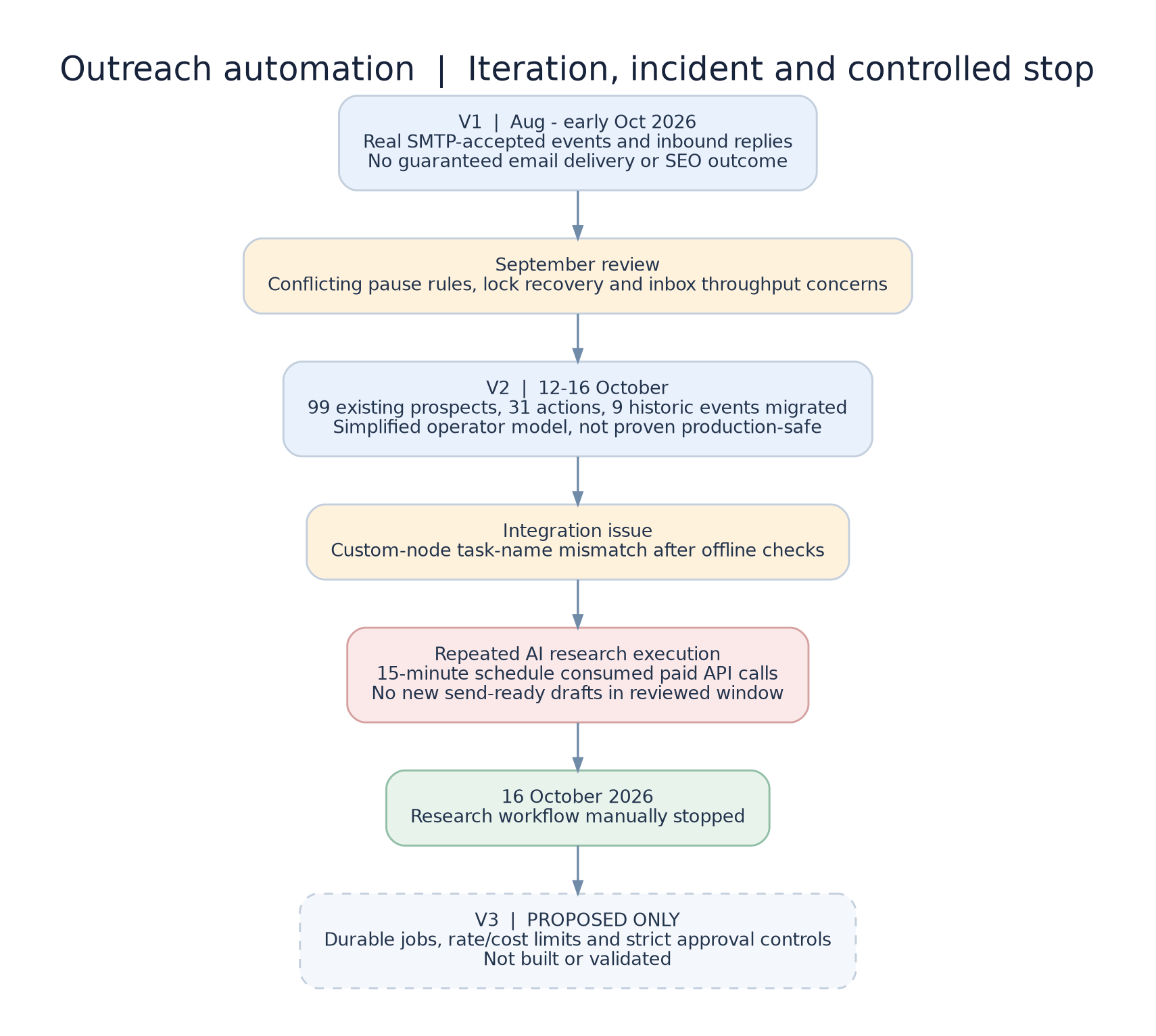
V1 joined research and evaluation with an operator-reviewed outbound process. Recorded paths include SMTP-accepted sends and reply processing. SMTP acceptance is not proof of inbox delivery or a commercial outcome.
V2 simplified the structure and migrated existing records. Its documented 99 prospects, 31 action rows and nine historical conversation events describe migration/history, not new acquisition, conversions or earned links.
A custom-node task mismatch passed offline checks but failed integration testing. That is a concrete limit on what source/configuration checks alone could establish.

Qualification and human approval
Research evidence and programmatic eligibility checks informed whether a potential contact could progress. AI helped evaluate material and prepare drafts; those outputs did not themselves constitute permission to contact someone.
Documented actual send routes used specific human approval. Reply and suppression handling were intended to prevent unsuitable follow-up, but the evidence does not establish race-free coordination across every path.
An approval, an SMTP-accepted action, a received reply and a business result remain different facts. None can safely stand in for the others.
The paid-run incident
A fifteen-minute paid AI research schedule kept running without producing new send-ready drafts in the period reviewed. I stopped it manually on 16 October 2026.
The evidence supports repeated paid execution and a deliberate shutdown. It does not support an exact incident bill, a total run count or an automatic cost breaker that had already solved the problem.
The incident showed that a workflow can be active while failing to advance its intended work. Cost, useful output and elapsed time need separate limits and operator visibility.
Known operational limits
Conflicting pause semantics, fragile lock recovery and reply/suppression throughput left coordination risks. Uncertain SMTP outcomes also made blind retries unsafe.
Some validation failures could occur before workflow guards ran. Local corrective checks do not prove that every external-action path had complete validation, recovery or automatic retry.
No guaranteed inbox delivery, exactly-once sending, backlink count, SEO uplift, quantified saving or autonomous production SLA is claimed.
V3: a design, not a shipped solution
The proposed redesign separates scoped jobs, stronger source validation and durable progress state. It adds budget/progress ceilings, bounded retries and explicit approval boundaries as design requirements.
These are lessons and a proposed direction. They must not be described as an implemented V3 or a retrospective description of the earlier system.
What changed in my approach
Validate the real integration boundary, not only exported configuration. Make pause and lock rules consistent, observe useful output as well as run count, and require an explicit human decision when a send outcome is uncertain.
Today I make cost and progress stop conditions part of the design. This present-day method developed through the historical work; it was not its exact original build sequence.